The Story of California Citrus: From Spanish Missions to Sunkist
A narrative history of California citrus — Franciscan mission groves, the Wolfskill orchard, the Tibbets navel orange trees, the rise of the California Fruit Growers Exchange, and the Sunkist brand that defined the American breakfast table.
The Story of California Citrus: From Spanish Missions to Sunkist
If you were to draw a single thread through California’s first 250 years of European settlement — connecting Junípero Serra, the Gold Rush, the transcontinental railroad, the rise of Los Angeles, and the invention of modern consumer advertising — that thread would be the orange. The story of California citrus is a story of seedlings carried up El Camino Real on muleback, of a Brazilian navel tree planted in a Riverside dooryard, and of a Los Angeles farmers’ cooperative that taught Americans to drink orange juice with breakfast.
Act I: The Mission Groves (1769–1834)
The Franciscan padres who established the chain of 21 Alta California missions between 1769 and 1823 brought with them the agricultural inventory of New Spain: grapevines, olives, figs, pomegranates, dates, and citrus. Mission San Gabriel Arcángel, founded in 1771, is generally credited with the first sustained citrus planting in California — a small grove of sour orange seedlings established around 1804 by Padre Antonio Peyri and his fellow missionaries. The trees were grown from seed brought up from Mission San Fernando de Velicatá in Baja California.
These were not commercial groves. The fruit was used for sacramental purposes, for the mission infirmary, and as part of the modest provisioning of soldiers and visitors. After secularization in 1834, the mission orchards passed into private hands — often into ruin — but the seed stock survived in dooryard plantings across the Mexican ranchos of the Los Angeles plain.
Act II: Wolfskill and the First Commercial Grove (1841)
The man usually credited with starting commercial citrus in California is William Wolfskill, a Kentucky-born trapper who arrived in Los Angeles in 1831, took Mexican citizenship, married into the prominent Lugo family, and in 1841 purchased a 100-acre tract along what is now Alameda Street in downtown Los Angeles. There he planted two acres of sweet orange seedlings purchased from the dwindling San Gabriel Mission orchard.
Wolfskill’s grove was, for a generation, the largest commercial citrus orchard in the United States. By 1862 he was shipping oranges by clipper ship around Cape Horn to San Francisco and by rail to the eastern mining camps. His son Joseph Wolfskill continued the business and is documented in the UC Davis Special Collections holdings on early California agriculture.
Act III: The Tibbets Trees and the Riverside Navel (1873)
In December 1873, Eliza Tibbets — a transplanted Ohio Spiritualist living in the new colony of Riverside — took possession of two budded navel orange trees that had been shipped from the USDA’s propagation greenhouses in Washington, D.C. The budwood had originated in Bahia, Brazil, where USDA agent William Saunders had identified a mutation producing a seedless, easy-to-peel, sweet orange. He had grafted the budwood onto rootstock in Washington and was distributing the resulting trees to growers across the country to see where the variety would thrive.
The two trees thrived in Riverside’s mild winters, alkaline soils, and dry summers. Within a decade their budwood had been propagated into tens of thousands of trees across the inland Southern California valleys. The Washington Navel — known commercially as the Riverside Navel — became the foundation variety of the California fresh orange industry. One of Mrs. Tibbets’s original trees is still alive and producing fruit at the corner of Magnolia and Arlington Avenues, registered as California Historical Landmark No. 20.
Act IV: The Cooperative — California Fruit Growers Exchange (1893)
By the late 1880s California growers had a marketing problem. Eastern wholesalers were extracting most of the profit from California citrus, and individual growers had no leverage. In 1893 a coalition of grower associations from Claremont, Pomona, Riverside, Redlands, and the San Gabriel Valley met and chartered the Southern California Fruit Exchange in Claremont, California — a non-stock cooperative that handled marketing on behalf of its grower-members and returned net proceeds, less cooperative expenses, in proportion to fruit delivered.
Renamed the California Fruit Growers Exchange (CFGE) in 1905, it became the most successful agricultural cooperative in American history. The internal records, packing-house contracts, and grower correspondence are preserved today at Cal Poly Pomona’s W. Keith and Janet Kellogg University Library, which holds the largest single archive of California citrus industry documents.
Act V: Sunkist and the Modern Brand (1908–1952)
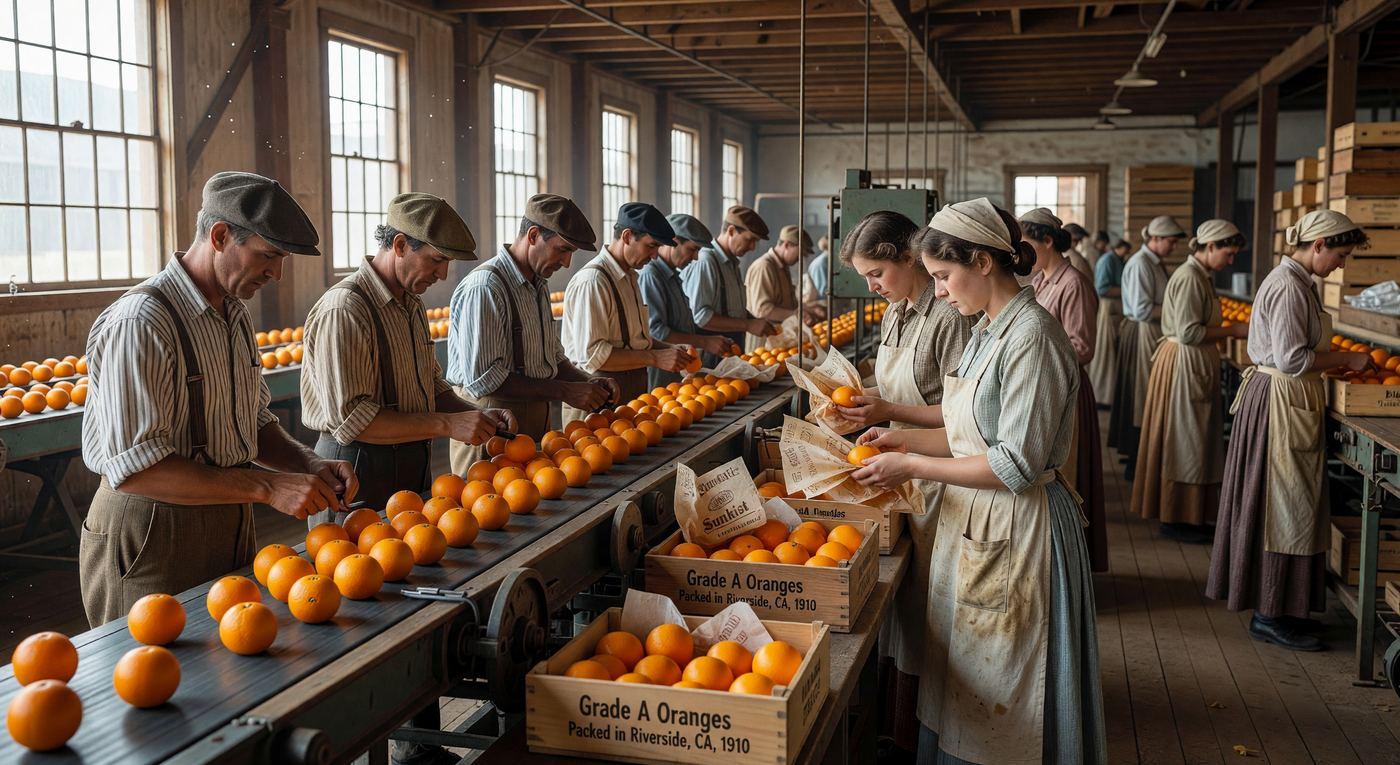
In 1908, in response to a market glut, the CFGE launched a national advertising campaign in cooperation with the Southern Pacific Railroad. The slogan — “Oranges for Health, California for Wealth” — appeared on billboards across the Midwest. The following year the cooperative adopted the brand name “Sunkist” (originally rendered as “Sun Kissed”) and began stamping it onto individual pieces of fruit using a tissue wrapper printed with the brand mark. It is generally regarded as the first branded fresh produce in American grocery history.
Sunkist’s most consequential innovation came in the 1920s and 1930s, when the cooperative — working with the Lord & Thomas advertising agency and the inventor of the modern juice press — successfully reframed the orange not as a holiday treat but as a daily breakfast beverage. The history of the Sunkist cooperative is documented in the company’s own corporate archives, in the CFGE collections at Cal Poly Pomona, and in the consumer advertising files held by the Smithsonian’s National Museum of American History.
Act VI: The Long Goodbye to the Citrus Belt
The story does not end with Sunkist’s mid-century peak. Between 1950 and 1980, the Southern California citrus belt — the corridor running from Pasadena through Pomona, Ontario, Riverside, and Redlands — was almost entirely converted to suburban housing, freeways, and industrial parks. The commercial industry migrated north into Tulare and Kern counties, where it remains concentrated today. The story of how the orange built Southern California, and then was paved over by it, is the closing chapter of the citrus era — and it is the story most worth understanding for anyone trying to make sense of how Southern California became what it is.
California’s citrus heritage is also a story of farm families — and of the women who often managed the books, the labor crews, and the household economies that kept grove operations solvent through the boom-and-bust decades. Financially Wise Women covers the modern continuation of that legacy, including the women now managing third- and fourth-generation California agricultural operations.